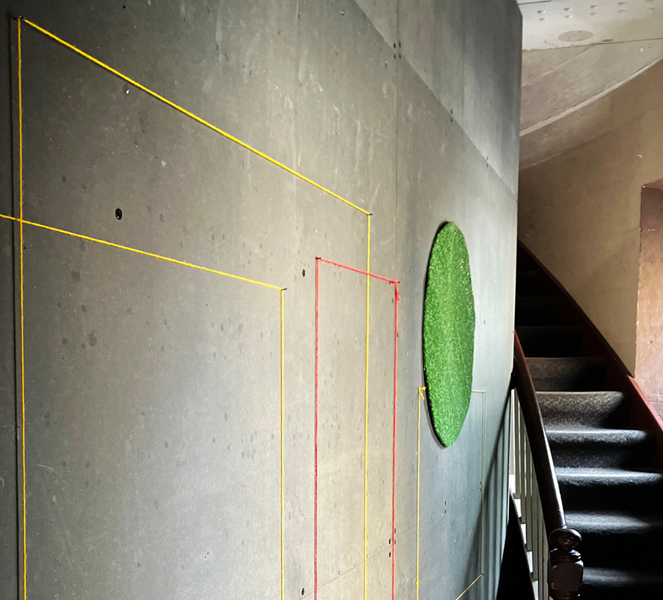
Is this enough for a likeness? is a drawing on the BACKSPACE wall at the National Art School, of the nearby access covers that are set in the bitumen outside the chapel building and outlined in yellow to prevent tripping. The drawing uses wool and tacks to collect their life-sized shapes on the BACKSPACE wall to see if that is sufficient to make a likeness (even though anyone can see that the actual covers have more to them—they are made of sturdier material, they are on the ground not on a wall, we believe they cover actual holes in the ground, and they have a different arrangement across the ground than the shapes do on the wall, and so on.)
This drawing is paired with another work in the Library’s upstairs FRONTSPACE that means that when someone sits in one of the lounge chairs there, they have the opportunity to see that the two shaped lawns in front of them are more or less repeated in the two side tables covered in ‘grass’ beside them. Again, anyone can see this ‘repetition’ is a stretch – the actual lawns are much bigger, they have a different shape to the side tables and so on. It is only the repetition of their location and of their own doubled grassiness that is used to make their likeness in FRONTSPACE—is that enough?
Both works are linked by their experimentations with likenesses, and also by each having a little of itself in the other—a yellow hula hoop from John Stanfield’s store (that happens to be the same size as the circular access cover) is located against the FRONTSPACE window (though it gets moved around sometimes), and a ‘grass’ circle (made of the same ‘grass’ material as the top of the circular side tables) is on the BACKSPACE wall to resemble the nearby circular access cover.
https://drawing.nas.edu.au/category/backspace-projects/
Is this enough for a likeness? is a continuation of a main strand of work in which the artwork merges with or is physically close by the actual space or object that is its subject. I understand that as characteristic of site-specific artwork concerned to advocate for the value of place rather than directly critique particular histories or particular ways in which it is used. These are not so very different when its considered that site specific artwork located in any culture that devalues the whole place(s) it inhabits—rather than caring for it—is implicitly critical of those values by enacting or modelling the opposite. Artwork can model the re-valuing of place by including the place in which it is located as an active part of the artwork, rather than being designed to be spatially independent of it. This strand includes:
When Circumferences become Diameters 2021
We Went to School Here 2020
Everyone can be a site-specific artist 2018
Saving Space 2015
Polygon Landscape 2013
NO BIG COAL 2012
BLACK 2011
Two Works One Wall 2010
TWIN 2010
air 2008
They dont live here anymore 2005